
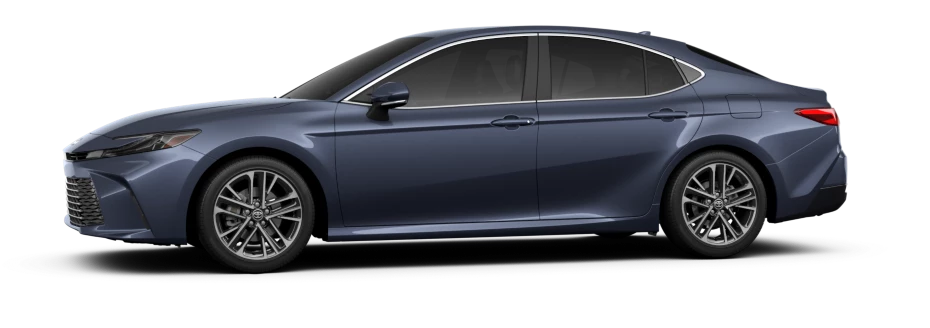
2026 Toyota Camry vs. Honda Accord, Hyundai Sonata, and Kia K5: How It Stacks Up
The midsize sedan class is more competitive than ever in 2026, and the Camry finds itself matched against three very different rivals depending on which trim you’re shopping: the value-focused Accord SE, the hybrid-for-hybrid Sonata Limited, and the performance-oriented K5 GT. Here’s how the Camry stacks up against each.
Camry SE vs. Honda Accord SE
This matchup highlights the Camry’s biggest advantage right out of the gate: every 2026 Camry is a hybrid, while the Accord SE runs a conventional turbocharged engine. The gap shows up immediately in the numbers — the Camry SE’s 2.5L hybrid puts out 225 net combined horsepower at an EPA-estimated 47 city / 45 highway / 46 combined MPG, compared to the Accord SE’s 192 horsepower and 28/36/31 MPG. That’s a 15-mpg combined advantage for the Camry, plus more power.
The Camry SE also pulls ahead on tech and comfort: a standard 12.3-inch touchscreen (versus available on some trims), standard smart key system, heated front seats, and Toyota’s Blind Spot Monitor suite with Rear Cross-Traffic Alert and Safe Exit Alert. The Accord counters with a longer roadside assistance window (3 years/36,000 miles vs. Toyota’s 2 years/unlimited miles) and very slightly more cargo room (16.7 vs. 15.1 cu.-ft.) and rear legroom.
Bottom line: if fuel economy and standard tech matter most, the Camry SE’s hybrid powertrain is hard to argue with against a non-hybrid Accord SE.
Camry XLE vs. Hyundai Sonata Limited Hybrid
This is the closest fight of the three, since both are hybrids competing at a similar trim level. The Camry XLE’s 225 hp edges out the Sonata Limited Hybrid’s 192 hp, though the Sonata claws back on efficiency with a slightly better highway number (51 mpg highway vs. Camry’s 47), even as the Camry wins combined (47 vs. 47 — a dead heat) and city driving.
Feature-for-feature, it’s a mixed bag. The Camry XLE offers an 8-way power-adjustable front passenger seat, 10-inch color head-up display, and Front and Rear Parking Assist with Automatic Braking — all things the Sonata Limited doesn’t match. The Sonata counters with a standout ownership perk: 5 years of unlimited-mile roadside assistance, more than double Toyota’s 2-year coverage, plus standard connected services (Bluelink+) where Toyota’s equivalent features run on trial subscriptions that eventually lapse. The Sonata also offers wired-only CarPlay/Android Auto, while the Camry’s is wireless — a small but real everyday convenience difference.
Bottom line: the Camry XLE wins on power and available luxury tech, but the Sonata Limited Hybrid makes a real case on long-term ownership value with its standard connected services and longer roadside coverage.
Camry XSE vs. Kia K5 GT (FWD)
This comparison isn’t hybrid vs. hybrid — it’s efficiency vs. raw performance. The Kia K5 GT ditches the hybrid approach entirely for a 2.5L turbo engine making 290 horsepower, a genuine 65-hp advantage over the Camry XSE’s 225. If you care about straight-line performance, the K5 GT wins that argument outright.
But that power comes at a real cost at the pump: the K5 GT is EPA-rated at just 23/33/27 MPG, nearly half the Camry XSE’s 47/45/46. That gap shows up starkly in Toyota’s own published ownership-cost estimates: over the ownership period, fuel costs alone are estimated at $5,456 for the Camry versus $9,629 for the K5 GT — a difference of over $4,000. Combined with lower estimated maintenance costs, total ownership cost favors the Camry at $58,974 versus $65,711 for the K5 GT, despite the Kia’s lower depreciation estimate.
Feature-wise the two trims trade blows fairly evenly — both offer premium audio, panoramic view monitors, heated and ventilated seats, and similar safety suites (Toyota Safety Sense 3.0 vs. Kia Drive Wise). The K5 GT does add a sport-tuned suspension and a longer roadside assistance window (5 years/60,000 miles vs. Toyota’s 2 years/unlimited miles).
Bottom line: choose the K5 GT if performance is the priority — it’s a genuinely quicker car. Choose the Camry XSE if you want most of the XSE’s sporty styling and tech without paying thousands more in fuel and maintenance over time.
The Bottom Line Across All Three
Across every comparison, the theme is consistent: the Camry’s standard hybrid powertrain gives it a fuel-economy advantage that ranges from meaningful to enormous, depending on which competitor you’re cross-shopping. The Accord SE and K5 GT don’t offer a hybrid option at these trim levels, so the Camry wins that category by default. The Sonata Limited Hybrid is the only true apples-to-apples fight — and even there, the Camry holds its own on power while the Sonata answers back with stronger standard connected services and roadside coverage.
If low running costs and hybrid efficiency are non-negotiable, the Camry is the easy pick against all three. If you’re chasing raw horsepower or specific standard features unique to a competitor, it’s worth a closer look at where your priorities actually sit.
Curious which Camry trim fits your driving needs? Stop by or reach out — happy to walk you through the lineup and find the right fit.