
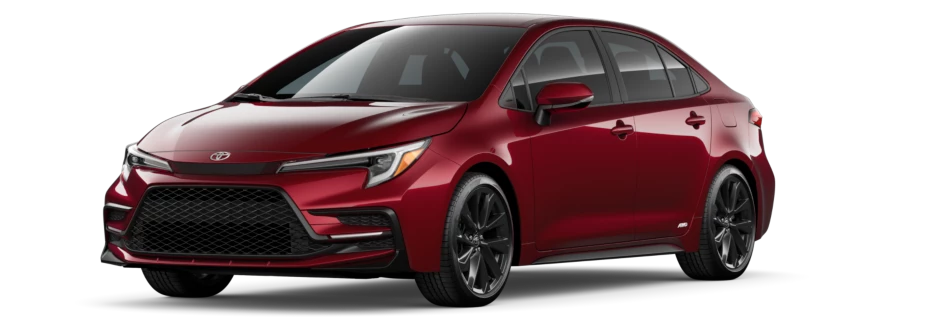
Why It’s Still the Smart Buy
If you’re shopping the compact sedan segment right now, you’ve probably got a browser full of tabs open — Corolla, Civic, Sentra, K4, Elantra. They all look great in photos, they all promise good gas mileage, and the salespeople (present company included) will all tell you theirs is the best. So let’s cut through it and actually compare the numbers.
We pulled the 2026 Corolla up against four of its biggest rivals: the Honda Civic Hybrid, Nissan Sentra, Kia K4, and Hyundai Elantra. Here’s how it actually shakes out.
Corolla Hybrid SE vs. Honda Civic Hybrid Sport
This is the matchup everyone asks about, and it’s honestly the closest fight on this list.
The Civic Hybrid wins on raw power — 200 net combined horsepower versus the Corolla’s 138 — and it edges out the Corolla on cargo room (14.8 cu. ft. vs. 13.1) and rear legroom (37.4 in. vs. 34.8 in.). If you want a hybrid that feels quicker off the line and hauls more stuff, that’s a real advantage for Honda.
But look past the spec sheet and the ownership picture gets more interesting. Fuel economy is a virtual wash (47 combined for the Corolla vs. 49 for the Civic). Where the Corolla pulls ahead is standard-feature value: a bigger 12.3-inch digital gauge cluster and available Qi wireless charging, neither of which the Civic offers.
The real separator is connected services. The Corolla Hybrid SE comes with trials for Service Connect, Safety Connect, Wi-Fi Connect, and Remote Connect — a full suite of safety and convenience features. The Civic doesn’t offer anything comparable.
To be straight with the numbers: on paper, Honda’s 5-year total cost to own actually comes in lower ($48,984 vs. the Corolla’s $52,954), and Honda’s maintenance costs are cheaper too ($4,624 vs. $6,804), since Toyota’s hybrid maintenance plan only covers 25,000 miles at 2 years compared to Honda’s shorter but cheaper 1-year/12,000-mile plan. Where the Corolla claws back ground is fuel costs ($5,504 vs. $5,275 — close) and, historically, resale value — Toyota’s reputation for holding value tends to pay off past the 5-year window these estimates cover.
Bottom line: if raw hybrid horsepower and interior space are your top priority, the Civic Hybrid has an edge. If you want more standard safety tech, better ownership perks, and Toyota’s legendary reliability reputation, the Corolla Hybrid SE is the safer long-term bet.
Corolla LE vs. Nissan Sentra S
This one isn’t close. The Corolla LE outguns the Sentra S in nearly every category that matters day to day: 169 hp vs. 149 hp, 151 lb-ft of torque vs. 146, and better EPA-estimated combined fuel economy (35 mpg vs. 33 mpg). The Corolla also comes standard with LED headlights and a Smart Key system, while the Sentra doesn’t offer either.
The Sentra does have a slightly bigger touchscreen (12.3 in. vs. 8.0 in.) and a bit more cargo room and rear legroom. But when it comes to active safety, Toyota Safety Sense 3.0 is a well-known, well-reviewed suite, and it’s standard across the Corolla lineup. Nissan’s connected services also lean more toward paid subscription tiers with shorter trial periods in some categories, while Toyota backs the Corolla with a minimum 5-year trial on Safety Connect and Service Connect.
Bottom line: more power, better efficiency, and stronger standard safety tech make the Corolla LE the more well-rounded choice here.
Corolla LE vs. Kia K4 LXS
The Kia K4 is a newer nameplate and it shows — Kia clearly wanted to make a statement with tech and features. The K4 offers a larger 12.3-inch touchscreen, more cargo space (14.6 cu. ft.), more rear legroom (38 in.), and a genuinely strong roadside assistance package at 5 years/60,000 miles, which beats Toyota’s 2-year/unlimited-mile coverage on paper for longer-haul reassurance.
Kia also throws in useful everyday touches Toyota doesn’t offer standard on the LE, like 4 USB-C ports.
That said, the Corolla still wins where it counts most for a daily commuter: better horsepower (169 vs. 147), more torque (151 vs. 132 lb-ft), and better fuel economy (35 mpg combined vs. 33). The Corolla also comes standard with automatic climate control and a smart key system, while the K4 LXS doesn’t offer either at this trim. And Toyota’s maintenance plan is included standard, while Kia doesn’t offer one at all on this trim.
Bottom line: the K4 has flashier tech and a longer roadside assistance window, but the Corolla is the stronger performer and comes with more comfort features built in from the factory.
Corolla SE vs. Hyundai Elantra SEL Sport
Both of these are the sportier trims in their respective lineups, and both are genuinely nice cars. The Elantra SEL Sport counters with more cargo space (14.2 cu. ft. vs. 13.1) and more rear legroom (38 in. vs. 34.8 in.), plus a longer roadside assistance window at 5 years/unlimited miles.
But the Corolla SE pulls ahead on performance (169 hp and 151 lb-ft vs. 147 hp and 132 lb-ft) and slightly better city and highway mileage. Toyota also equips the SE with an available 12.3-inch digital gauge cluster and 10.5-inch touchscreen, while those aren’t offered on the Elantra SEL Sport at all. On the connected services side, the Corolla again has the fuller suite — Service Connect, Safety Connect, Wi-Fi Connect, and Remote Connect trials — where Hyundai’s Bluelink is available but the maintenance plan isn’t offered on this trim.
Bottom line: the Elantra is roomier, but the Corolla SE is quicker, more efficient, and better equipped with driver tech.
So, Which One Should You Actually Buy?
Here’s the honest read after putting all four side by side:
- Want the most horsepower in a hybrid? The Civic Hybrid Sport has it, but you give up connected services and a shorter maintenance window.
- Want the best all-around value in a gas-only compact? The Corolla LE beats both the Sentra and the K4 on power, efficiency, and standard features.
- Want more backseat and cargo room above everything else? The Elantra, K4, and Civic all offer more space than the Corolla — that’s the one category where Toyota consistently gives up ground.
- Want the reputation for reliability, resale value, and a full suite of standard safety tech? That’s where the Corolla has built its name for almost 60 years, and the 2026 model doesn’t change that formula.
No car is the objectively “best” one for every driver — it depends on whether you’re prioritizing space, power, tech, or long-term ownership costs. But if you want a compact sedan that’s going to be dependable for the next decade, hold its value, and come loaded with Toyota Safety Sense 3.0 standard, the 2026 Corolla is hard to beat in this class.
Have questions about which Corolla trim fits your budget and daily drive? Drop a comment or send a message — happy to walk you through it.